Why I would buy it
- Interior space
- Feature list
- Practicality
Why I Would Avoid It?
- Understated looks
- Only one battery pack option
Introduction

MG has launched its first big EV for the Indian market as part of its push for a NEV-based lineup for the future. The first car from this is the MG Hector Tomahawk, and in this case, we have got behind the wheel of the BEV. It can be had in both five-seat and seven-seat guises and is MG's fighter in a growing new segment of large three-row vehicles, offering multiple powertrain options and loaded to the gills with features.
Exterior
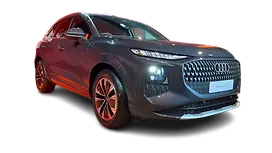
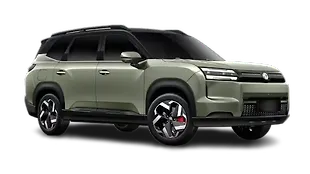
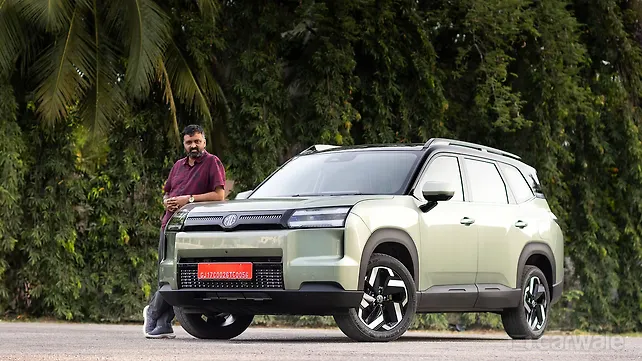
Up front, the face is flat with dual-stack LED DRLs, full-LED headlamps, and a large MG logo in the middle. Move over to the side and you can see the nice 20-inch diamond-cut alloy wheels with the pop-out door handles and large black OVRMs. It is also here that you can see the large overhangs of the vehicle at both ends. Move over to the rear and the connected tail lamps and Tomahawk badging dominate the proceedings, adding well to the overall image of the car.
On paper, the Tomahawk should not be hard to miss on the road. It is 4.8 metres and has a wheelbase of 2.8 metres. What's more, the colour palette is not bright, but it is not subtle either. But look at the car in real life, and the picture comes out slightly different. None of the design elements pops out, and the longer you look at the car, the more you see elements of the regular MG Hector giving it that younger-brother/older-brother vibe (which they are anyway). Each of its main rivals is the Mahindra XEV 9s and the Kia Carens Clavis EV.
Interior
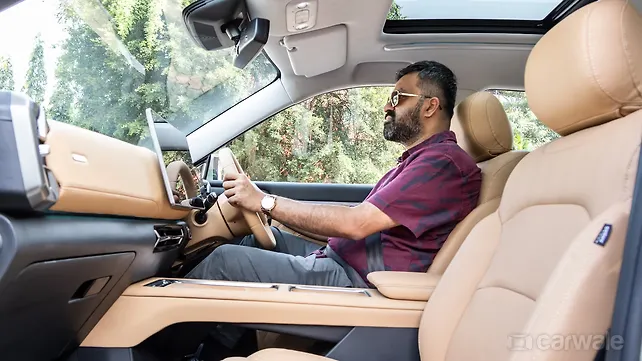
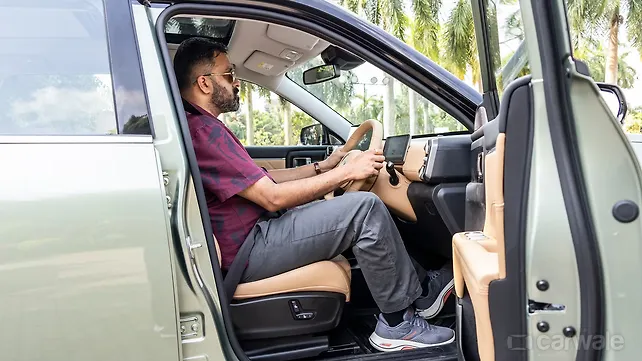
The top-spec versions get a tan-brown interior, which is all over the cabin, including some of the lower sections on the dashboard. The colour is light and pleasing to the eyes but is very susceptible to dirt and stains if not regularly cleaned. As a space to spend hours on the road, the overall cabin ambience is an airy and light space thanks to the large glasshouse, windows, panoramic sunroof, and of course the tan-brown interiors.
Everything looks and feels nice to touch, though there isn't all that much in terms of physical buttons, as a large chunk of the functions have been crammed into the massive 15-inch touchscreen infotainment system. All the contact surfaces have been covered in soft-touch materials, and most of whatever physical controls exist fall easily to hand. The interior feels very typical MG-like in terms of look and feel, and that's both a good thing and a bad thing. The former as it now gives Indians an idea of the MG identity, whilst on the flip side there is too much brown and it looks very similar to what's being offered on cars like the Windsor, Comet, and even the Hector.
Features
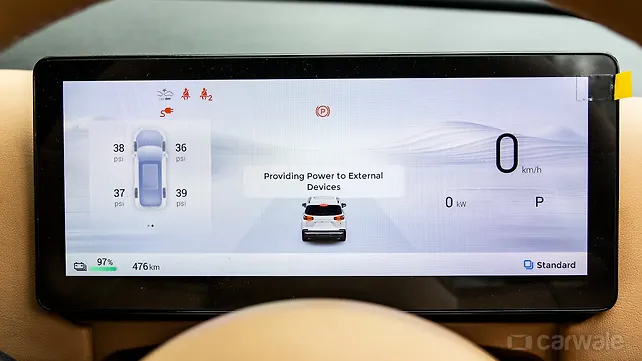
The feature list is pretty hefty and is in fact, one of the USPs of this vehicle. The standard stuff includes the likes of dual digital screens with a 15.6-inch unit for the infotainment system and an 8.8-inch unit for the instrument cluster, climate control with rear AC vents, USB-C fast-charging ports at the front and rear, wireless charger, i-Smart 3.0 connected car technology, powered and ventilated front seats, Level-2 ADAS, panoramic sunroof with multi-language support, rear sun blinds, V2H, V2L, full-LED light package, and to add that little extra touch—cabin modes including one for your four-legged friends.
Storage
The big cabin means there is a lot of storage all around, combining the standard bits with some extras too. All the doors get 1.0-litre bottle holders and map pockets, whilst all variants get seatback pockets and a storage space below the USB charging ports if you have selected the five-seat models.
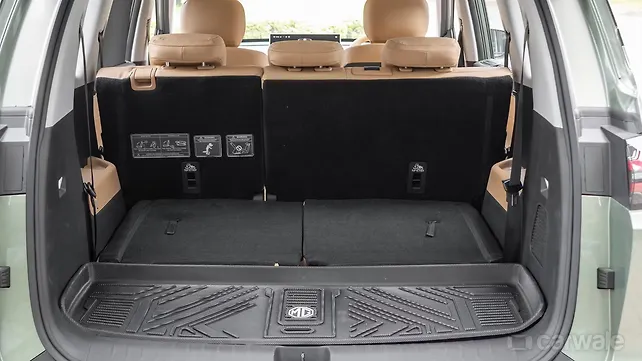
The front glovebox is not deep but is wide and easy to access, whilst one of the big storage highlights is an under-front centre console cubbyhole offering as much storage as the capacity of the console itself. There is no frunk, but you get a massive boot space of 610 litres in the five-seat model and 192 litres/528 litres in the seven-seat model with the third row up/down, respectively.
Infotainment system
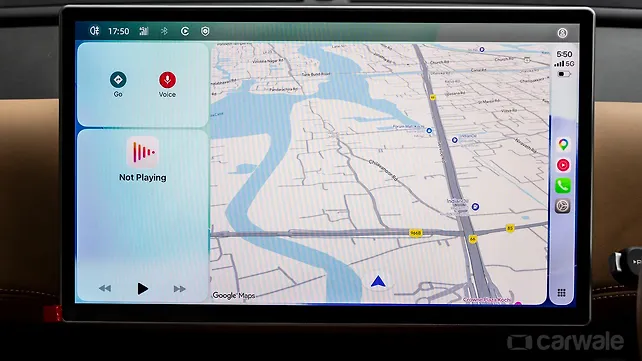
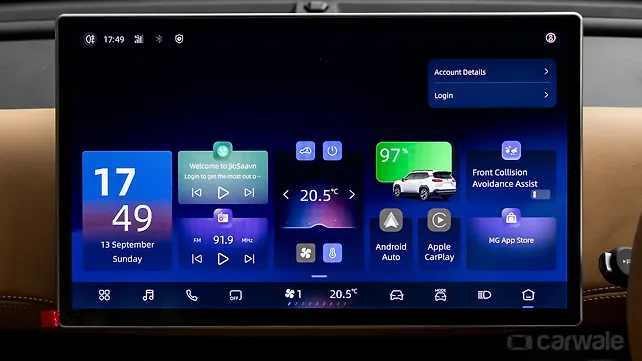
MG has always liked it big when going in for infotainment systems, and this one at 15.6 inches is massive by any standard. It runs the same OS as what you get on most MG cars but with added features that you would expect from a car at this price point. The screen is responsive, bright, and is designed in such a manner that you aren't taking too many steps to reach a function.
However, the graphics could do with an update, and despite the physical controls, there are still way too many functions crammed into the screen. This list includes the regen controls, ADAS controls, drive mode controls, and cabin mode controls. It makes light work of allowing you to switch to phone mirroring, but because there are no physical buttons, you have to trace your way back significantly to access the car's functions. What's more, whilst the car gets a 360-degree camera package with an underbody view, the resolution offered by the camera is quite poor and will struggle in low-light conditions.
Safety
All versions of the Tomahawk EV get six airbags, ESP, traction control, ABS with EBD, TPMS, and ISOFIX child seat mounting points. The 360-degree camera package with the underbody view is only offered in the Exclusive and Essence variants, whilst the Level-2 ADAS only comes on the top-spec five-seat and seven-seat Essence variants. The ADAS functions are effective but lack rear cross-traffic alert capability.
Performance
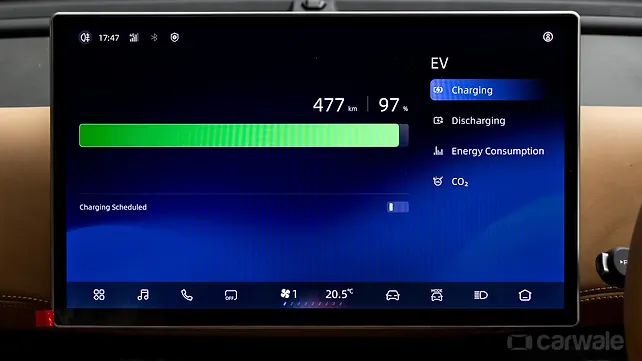
You only get the Tomahawk with one battery pack, which is a 69.2kWh unit mated to a 201bhp/310Nm motor powering the front wheels. This is the only powertrain option you get for the Tomahawk EV. The claimed range stands at 517 km, and with a maximum of 90kW DC fast charging, you can go from 30–80 per cent in 35 minutes.
The powertrain does exactly what it is supposed to do, which is to ensure that you get a nice burst of motivation every time you press the throttle but at the same time sip power economically and ensure that you get a good range. Peak torque is instant, and movement is almost effortless, and that's considering the large battery pack and three rows of seats.
MG has dialled in customisability in the overall drive experience by offering drive modes. These comprise Eco, Standard, Sport, and even a Custom mode. It alters the response of the throttle, and the difference between Eco and Standard is minimal whilst Sport takes it up significantly. In Custom mode you can set the exact level of regen and power response via a percentage dial, and at full tilt the former is surprisingly non-intrusive whilst the latter induces noticeable torque steer, pulling the car to one side. It's a fun little addition and will take you by quite a surprise if you are uninitiated.
Ride and Handling
Where the Hector was soft and the Windsor too firm, this one has managed to arrive in the middle, with a ride quality that is firm but settles quickly when you go over large bumps and imperfections. It's also got 230mm ground clearance, and that means even with seven people and luggage on board, you are not going to scrape the battery, and that's even if you go hard into a pothole.
The steering weighs up nicely as you go faster but lacks much feel, especially in the dead-ahead position. However, as we had mentioned earlier, if you gas the throttle hard in the 100 per cent power setting in Custom drive mode, the steering has a tendency to pull to the left as the car undergoes torque steer.
NVH
The NVH insulation is fantastic with very little filtering into the cabin. The road, wind, and tyre noise is well contained and if you are going to use the car in chauffeur mode, then this will be a very good option.
Verdict
There are a few things to be noted here when summing up the car. It's spacious, feature-loaded, offers good range, and has a massive boot if you drop the second row across both seating options. On the flip side, it only comes with one powertrain; the five-seat option is only available as a top-spec version, and whilst it is a very large car on paper, its overall design is subtle and tends to mask the car's ability to be a statement piece. Prices for this top-spec Essence that we have driven are Rs. 23 lakh for the five-seat version and Rs. 23.49 lakh for the seven-seat model. If you buy it under a BaaS programme then it is Rs. 17 lakh for the five-seat model and Rs. 17.49 lakh for the seven-seat model and Rs. 4.90 per kilometre. Rivals for the Tomahawk EV include the Kia Carens Clavis EV and the Mahindra XEV 9s.
Photography: Kaustubh Gandhi